

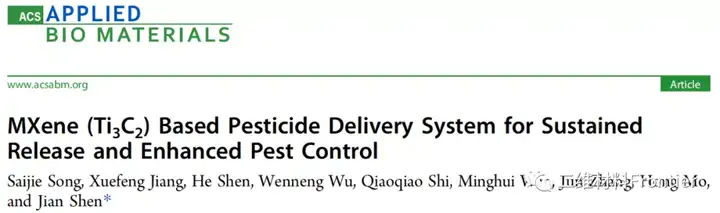
ACS Appl. Bio Mater.: Pesticide slow-release enhanced pest control system based on MXene (Ti3C2)
one. Article overview
A pesticide delivery system based on multifunctional nanomaterials provides a powerful strategy for the effective use of pesticides. The author here introduces to us the application of a two-dimensional MXene (ti3C2) nanomaterial in pesticide transportation and plant protection. Abamectin (AV), a hydrophobic and unstable insecticide, was chosen as a model insecticide. In the author’s research, AV@ti3C2 is formed by the rapid adsorption of AV on Ti3C2, with a maximum adsorption capacity of 81.44%. Compared with hydrophobic AV, the water solubility of AV@Ti3C2 is significantly improved, which helps to ensure the biological activity of pesticides. AV@Ti3c2 nanomaterials exhibit a pH-responsive slow release behavior, which overcomes the burst release of traditional AV formulations. In addition, AV@Ti3C2 has good light stability under ultraviolet light, which prolongs the duration of AV. Therefore, according to biological activity determination, AV@Ti3C2 has maintained and enhanced anti-pest activity. The biological safety of AV@Ti3C2 is satisfactory, and it has no negative effects on the germination and growth of corn. The current research provides a potential candidate material for pest control. AV@Ti3C2 also broadens the application of 2DMXene materials in plant protection and sustainable agriculture.
Two, graphic guide
A pesticide delivery system based on multifunctional nanomaterials provides a powerful strategy for the effective use of pesticides. The author here introduces to us the application of a two-dimensional MXene (ti3C2) nanomaterial in pesticide transportation and plant protection. Abamectin (AV), a hydrophobic and unstable insecticide, was chosen as a model insecticide. In the author’s research, AV@ti3C2 is formed by the rapid adsorption of AV on Ti3C2, with a maximum adsorption capacity of 81.44%. Compared with hydrophobic AV, the water solubility of AV@Ti3C2 is significantly improved, which helps to ensure the biological activity of pesticides. AV@Ti3c2 nanomaterials exhibit a pH-responsive slow release behavior, which overcomes the burst release of traditional AV formulations. In addition, AV@Ti3C2 has good light stability under ultraviolet light, which prolongs the duration of AV. Therefore, according to biological activity determination, AV@Ti3C2 has maintained and enhanced anti-pest activity. The biological safety of AV@Ti3C2 is satisfactory, and it has no negative effects on the germination and growth of corn. The current research provides a potential candidate material for pest control. AV@Ti3C2 also broadens the application of 2DMXene materials in plant protection and sustainable agriculture.
Two, graphic guide
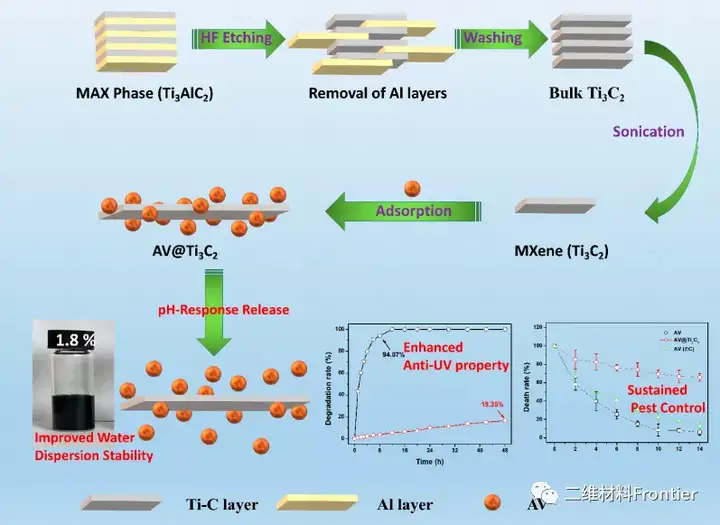
Figure 1. Synthesis of Ti3c2 and its application in compartment transportation and pest control.
It is efficiently loaded on ti3C2 by fast adsorption, forming a uniform and stable AV@ti3C2 nano-formulation. Unlike the rapid loss of AV, AV@ti3c2 exhibits ph response release behavior. In addition, the stability of AV@Ti3C2 under ultraviolet light is significantly improved, which further ensures its long-term activity. Therefore, AV@Ti3C2 showed enhanced anti-insect activity 14 days after spraying.
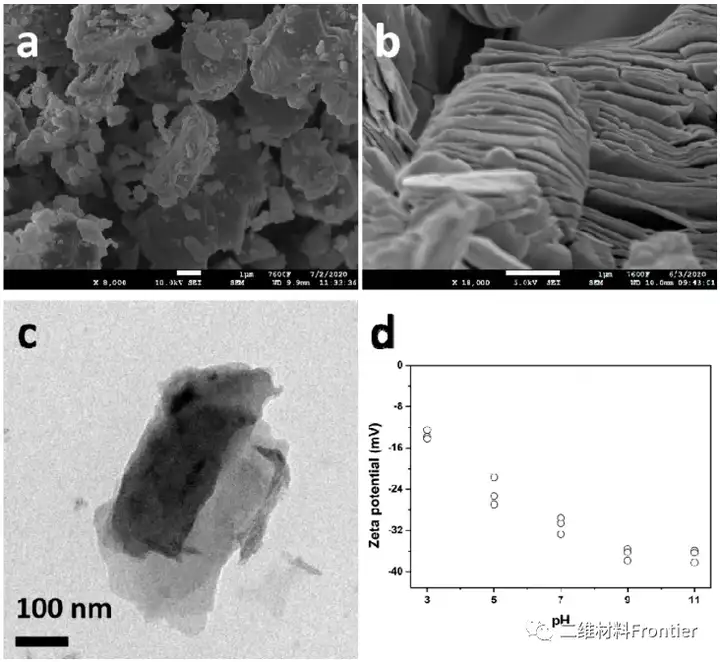
Figure 2. Scanning diagram of the structure of MXene.
In the above figure, (a) Ti3AlC2, (b) the electron microscope image of a large Ti3C2. (c) Transmission electron microscope image of ti3c2 nanosheet. (d) Zeta potential of Ti3C2 nanosheets. Before HF etching, Ti3AlC2 showed a dense stacked layer. After removing the Al layer from Ti3AlC2, the structure of the Ti3C2 body becomes fluffy, which is similar to an open accordion. Under strong ultrasonic treatment, the accordion-like structure was exfoliated into two-dimensional MXene phase Ti3C2 nanosheets.
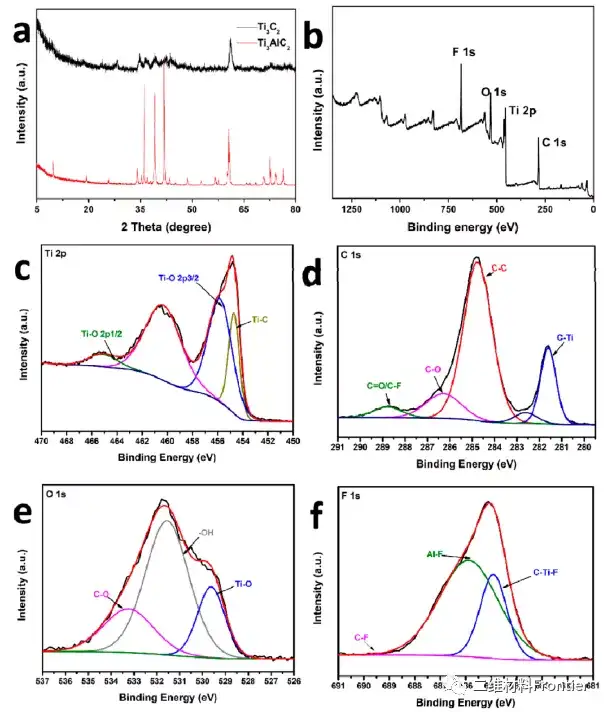
Figure 3. Structural characterization diagrams of Ti3C2 and Ti3AlC2.
In the figure above, (a) XRD spectra of ti3C2 and ti3AlC2. (b) XPS measurement spectrum of ti3c2. High-resolution XPS spectroscopy (c) ti2p. (d) C1s. (e) O1s. (f) F1s.
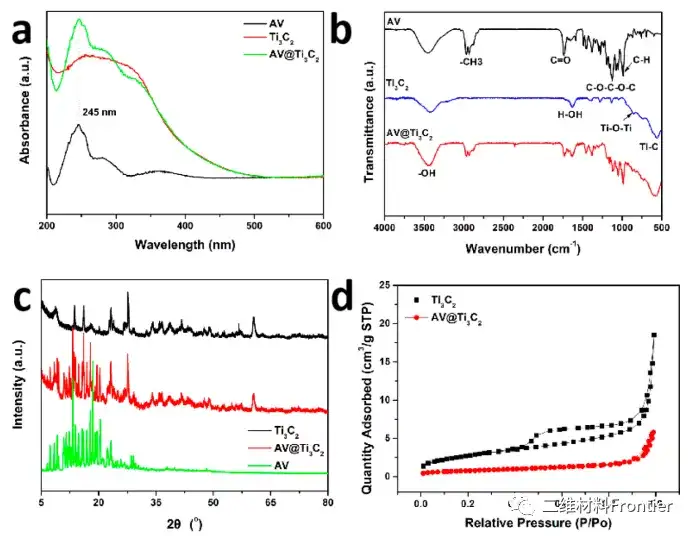
Figure 4. The performance and structure characterization diagram of AV and Ti3C2 materials.
As shown in Figure 4, the zeta potential of AV@Ti3C2 is approximately −23.1mV. The negative surface charge and electrostatic repulsion also contribute to the stability of the pesticide-loaded MXene. In Figure 4a, we can see that at 245nm, a strong peak appears in AV@ti3C2, which further proves that AV has been successfully loaded on ti3C2 nanocarriers. The FTIR spectrum is shown in Figure 4b. In 4c, after loading AV onto Ti3C2, the characteristic peaks of AV and Ti3C2 appeared in AV@Ti3C2.
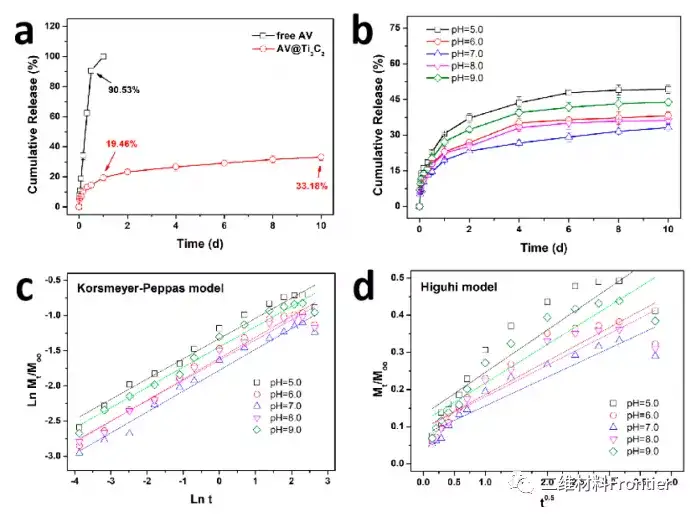
Figure 5. Release behavior diagram of pH reaction.
(a) Release curves of free AV and AV@Ti3C2. (b) The release curve of AV@Ti3C2 at different pH values. (c) Cosmeyer model. (d) Port model.
3. Full text summary
In summary, in this study, the author successfully constructed a PH-responsive release of AV@ti3c2 nano-pesticide and sustained pest control. Through the rapid adsorption of AV on Ti3C2 nanosheets, the resulting AV@Ti3C2 has better water solubility and stability. The controlled release performance and enhanced UV resistance of AV@Ti3C2 contribute to its long-term activity, thereby reducing the amount of pesticides and spraying time. In addition, AV@Ti3C2 has good biological safety and has no side effects on seed germination and seedling growth. Therefore, the typical MXene nanomaterial Ti3C2 will have a wide range of applications in pest control and modern agriculture.
Article link:
https://pubs.acs.org/doi/10.1021/acsabm.1c00607
This information is sourced from the Internet for academic exchanges only. If there is any infringement, please contact us to delete it immediately.
3. Full text summary
In summary, in this study, the author successfully constructed a PH-responsive release of AV@ti3c2 nano-pesticide and sustained pest control. Through the rapid adsorption of AV on Ti3C2 nanosheets, the resulting AV@Ti3C2 has better water solubility and stability. The controlled release performance and enhanced UV resistance of AV@Ti3C2 contribute to its long-term activity, thereby reducing the amount of pesticides and spraying time. In addition, AV@Ti3C2 has good biological safety and has no side effects on seed germination and seedling growth. Therefore, the typical MXene nanomaterial Ti3C2 will have a wide range of applications in pest control and modern agriculture.
Article link:
https://pubs.acs.org/doi/10.1021/acsabm.1c00607
This information is sourced from the Internet for academic exchanges only. If there is any infringement, please contact us to delete it immediately.
18915694570
Previous: ACS Pharmacology & Tra